How Arctic Blast Works: Menthol, Camphor & Cooling Sensation
How Arctic Blast works based on its labeled active ingredients and independent menthol/camphor research, without overstating finished-product evidence.
Step 1: Menthol activates cooling-sensitive pathways
TRPM8 is a temperature-sensitive ion channel expressed in sensory neurons. Menthol is a well-known TRPM8 agonist. Reviews of topical menthol describe a cooling sensation and counter-irritant effects that can alter how minor aches are perceived. Research also suggests additional effects on ion channels and nociceptive signaling.
Step 2: Camphor adds another sensory-active component
Camphor has a long history of topical use and has been studied for interactions with transient receptor potential channels. Laboratory work has reported activation and desensitization of TRPV1 as well as effects on cold-sensitive neurons. Human product performance depends on concentration, formulation, application and individual response, so mechanistic findings should not be converted into guaranteed outcome claims.
Step 3: The topical vehicle carries the active ingredients
The label also lists a mixture of water, alcohols, oils, botanical extracts, DMSO and formulation ingredients. These can affect texture, evaporation, skin feel and delivery characteristics. However, the current Drug Facts record still identifies only menthol and camphor as active ingredients.
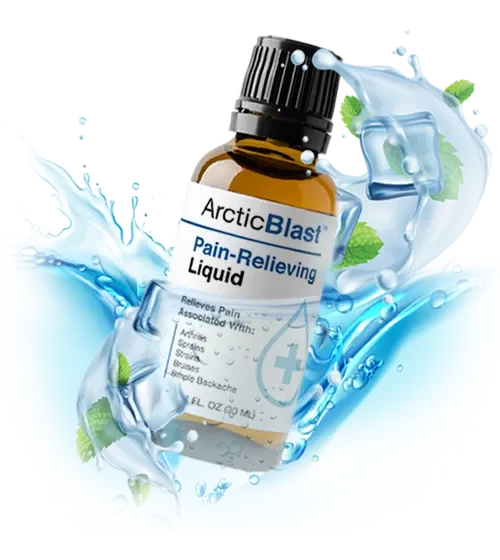
What “cooling” does — and does not — mean
A cooling sensation is a sensory effect. It is not evidence that tissue temperature has been dramatically lowered, that inflammation has been cured, or that the underlying cause of pain has been eliminated.
Arctic Blast’s label is appropriately narrower: temporary relief of minor aches and pains of muscles and joints associated with listed conditions such as sprains, strains, bruises, arthritis and simple backache.
What evidence would be needed to call the finished product “clinically proven”?
That phrase would require reliable, product-specific clinical evidence on the finished Arctic Blast formulation and the exact outcomes being claimed. Ingredient studies alone are insufficient because the finished product contains multiple components and has its own concentrations, vehicle and directions.
Review the current offer
After reviewing how the active ingredients are labeled and the safety information, check the current package options if you want to continue.
View Current Package OptionsCounter-irritation is a sensory concept, not a cure claim
Topical counter-irritants create sensations such as cooling or warmth that can modify the perception of minor aches at the application area. That mechanism is different from saying the underlying joint, muscle or connective-tissue cause has been repaired. The distinction matters because marketing language can easily turn a sensory mechanism into a disease-treatment claim that the label does not make.
Menthol research is useful because it provides a mechanistic basis for cooling sensation and analgesic signaling through TRPM8 and other pathways. Camphor research likewise shows sensory-channel effects. But a finished topical formula contains a vehicle, multiple inactive ingredients and a defined concentration of actives. Product-specific performance cannot be reconstructed perfectly from ingredient papers.
Setting realistic expectations
The label uses the phrase “temporary relief of minor aches and pains.” That is the most defensible expectation to carry into a purchase decision. It does not promise a particular onset time, percentage improvement, duration for every person or permanent resolution. Individual experience can vary, and persistent or worsening symptoms fall outside the intended self-care window described in the warnings.
Mechanism explains possibility, not guaranteed magnitude
Knowing that menthol activates TRPM8 helps explain why a product can feel cool. It does not tell us exactly how much relief every user will experience, how quickly it will begin, or how long it will last. Those outcome questions require product-specific human evidence under defined conditions.
Likewise, identifying camphor interactions with sensory channels is scientifically informative but not equivalent to a claim that the product “switches off pain signals.” Sensory systems are complex, and the label itself uses the more modest and appropriate language of temporary relief.
The role of the vehicle
Alcohols, water, oils, solubilizers and other inactive ingredients affect how a topical liquid spreads, evaporates and feels on the skin. That can influence the user experience, but the site does not assign therapeutic claims to the vehicle ingredients unless the product label or reliable evidence supports that claim.
References
- DailyMed — Arctic Blast Pain Relieving (menthol, camphor synthetic) liquid
- Pergolizzi JV Jr, et al. The role and mechanism of action of menthol in topical analgesic products. J Clin Pharm Ther. 2018.
- Liu B, et al. TRPM8 is the principal mediator of menthol-induced analgesia of acute and inflammatory pain. Pain. 2013.
- Xu H, et al. Camphor activates and strongly desensitizes the TRPV1 channel. J Neurosci. 2005.
- Vetter I, et al. Amplified cold transduction in native nociceptors by M-channel inhibition. J Neurosci. 2013.